Version 3 of Valuatic introduced a new tagging feature.
The tagging feature provides a structured way to manage, flag, and filter data within Valuatic Studio.
Tags can be used to augment with more information for organizational purposes (e.g. mark a record as draft),
or it can be used to filter records that are only meant to be used at a specific time (like in an OSCE schedule).
Tag Management
Tags are defined in the Valuatic Studio Configuration.

- You can create tags with customizable names and colors to visually distinguish them.
- Tags can be reordered by drag&drop, influencing the sorting possibilities of associated records.
- They can be assigned to forms, examiners, and candidates.
- Each tag has statistics, showing how many records of each content use this tag.
Note: When you remove a tag, it will also be removed from all records using this tag.
Tag Assignment

In each content area (forms, examiners, and candidates), there is a new tags side-panel. You can add or remove tags from selected records using this panel. By selecting multiple records, tags can also be applied simultaneously.
- For each tag, the amount of its usages within the respective content is shown.
- Tags applied on participants can also be imported and exported.
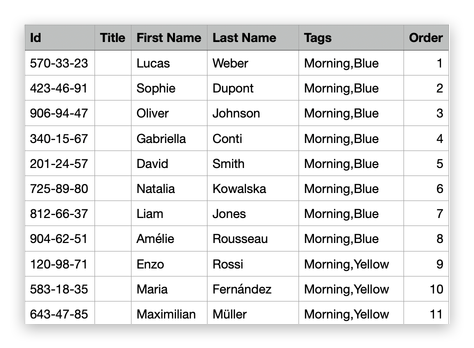
Participant lists are usually prepared in Excel, with one row per participant and the columns ID, Title, First Name, Last Name, Tags and Order. Separate several tags with commas.
To import the list, save it in Excel with File > Save As and the file format CSV UTF-8. The name of this format depends on the language of Excel:
| Excel language | File format |
|---|---|
| English | CSV UTF-8 (Comma delimited) (*.csv) |
| German | CSV UTF-8 (durch Trennzeichen getrennt) (*.csv) |
| French | CSV UTF-8 (délimité par des virgules) (*.csv) |
| Italian | CSV UTF-8 (delimitato da virgole) (*.csv) |
If a participant with the same ID already exists when participants are imported, the content of the existing candidate will be replaced.
This allows you to update tags easily, as they are replaced by the ones in the new import records.
Note: If a tag is part of the import that has not yet been created in the configuration, it will be created automatically.
Note: The Order column is optional. It is used by Scheduling to place examiners and candidates when the stations are generated.