The scheduling feature has not been released yet — it will be available with Valuatic 4.0.
This documentation is preliminary and subject to change.
Subscribe to our newsletter to get notified when it becomes available.
Scheduling
The scheduling feature provides a structured way to plan OSCE exams within Valuatic Studio by assigning forms, examiners, and candidates to rotations and stations.
An OSCE (Objective Structured Clinical Examination) is a performance-based exam where candidates rotate through a series of stations, each assessing a specific clinical skill. At every station, an examiner evaluates the candidate using a predefined form.
Building such a schedule can be complex, especially for large exams running across multiple days, rooms, or parallel tracks. Valuatic simplifies this by letting you organize your content with tags and then assemble rotations and stations from it.
Note: Scheduling builds on the Tagging feature. Tags are the link between your content and your schedule — they define which items belong together in a rotation.
Configuration
Scheduling can be activated on the Scheduling tab of the Configuration screen using the Use Scheduling toggle.
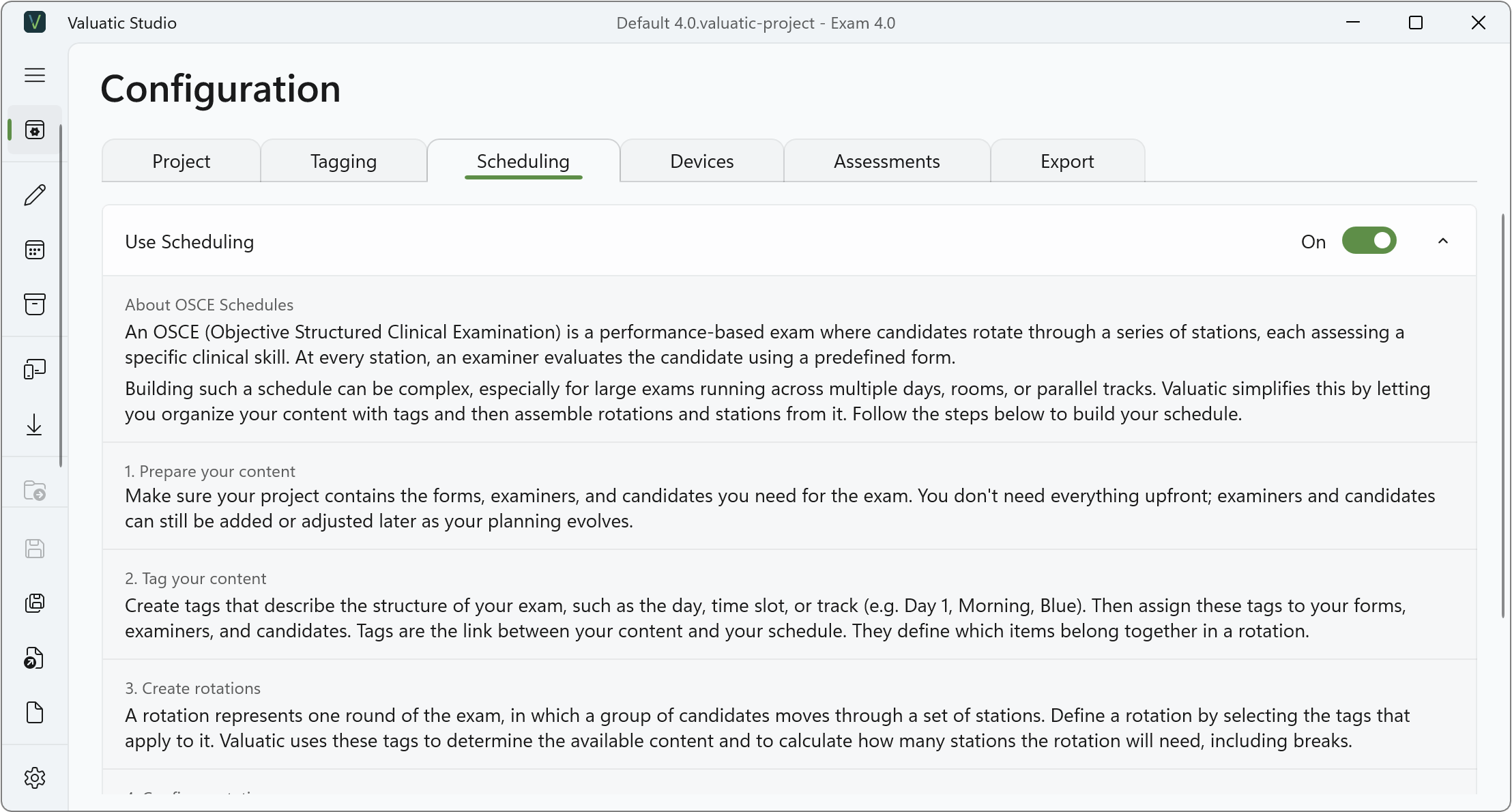
The configuration screen also provides a short summary of the recommended workflow:
- Prepare your content - Make sure your project contains the forms, examiners, and candidates you need for the exam. You don’t need everything upfront; examiners and candidates can still be added or adjusted later as your planning evolves.
- Tag your content - Create tags that describe the structure of your exam, such as the day, time slot, or track (e.g. Day 1, Morning, Blue). Then assign these tags to your forms, examiners, and candidates.
- Create rotations - A rotation represents one round of the exam, in which a group of candidates moves through a set of stations. Define a rotation by selecting the tags that apply to it.
- Configure stations - Generate the stations automatically or create and assign them manually.
Rotations
When scheduling is active, the Schedule screen is available in the navigation on the left-hand side. The Rotations tab lists all rotations of your project with their validation state, name, and assigned tags.
The following actions are available:
- New… opens the Create Rotation dialog.
- Edit opens the selected rotation to change its tags or name.
- Delete removes the selected rotation including its stations.
- Double-clicking a rotation opens its detail screen.
Create Rotation
A rotation is defined by a set of tags. Content items (forms, examiners, candidates) must match all selected tags to be part of the rotation.
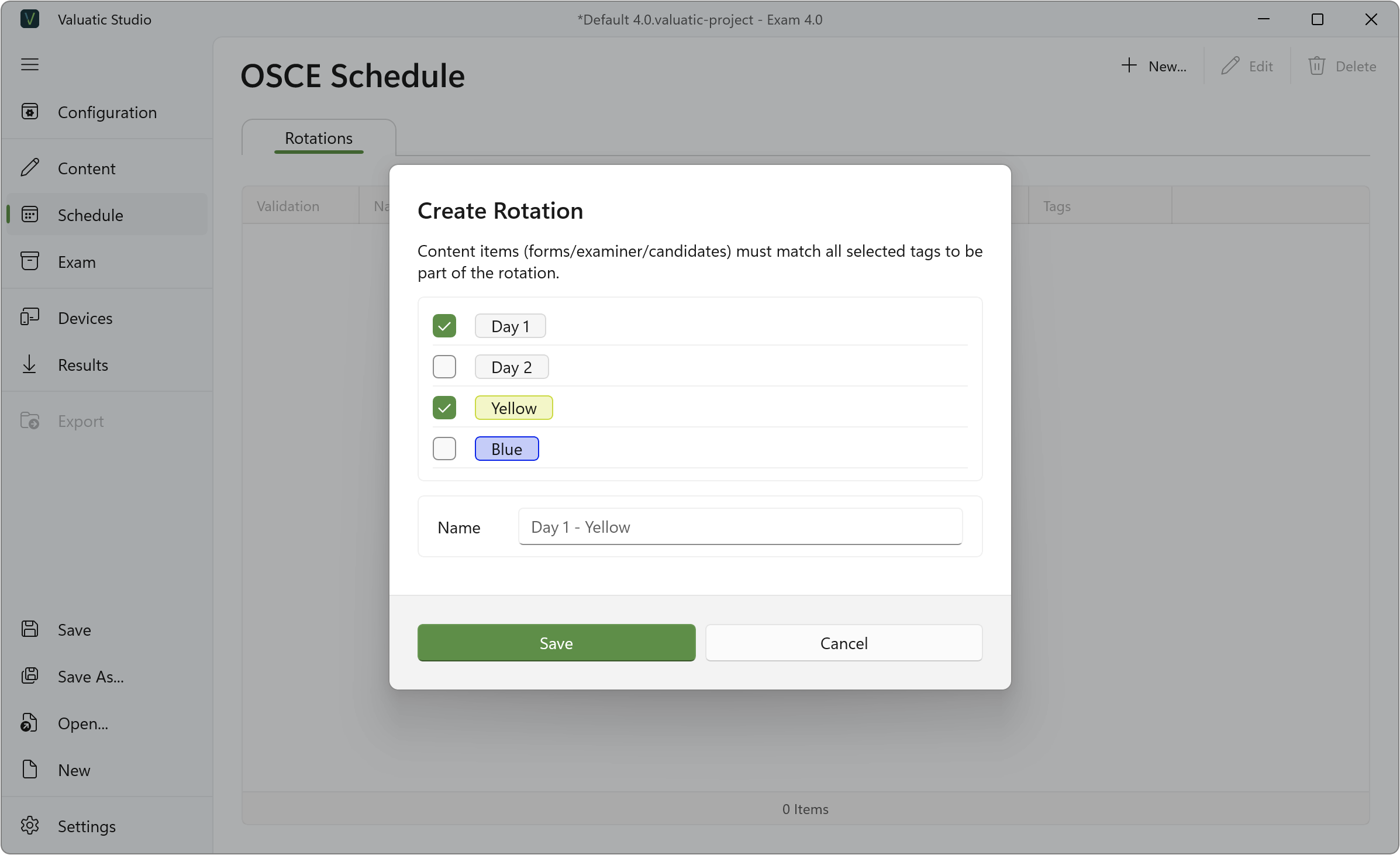
Select the tags that describe the rotation (e.g. Day 1 and Yellow). A name is suggested automatically based on the selected tags but can be changed to any custom name.
Valuatic uses the selected tags to determine the available content and to calculate how many stations the rotation will need, including breaks.
Stations
The detail screen of a rotation shows its stations. Use the dropdown next to the rotation name in the breadcrumb to quickly switch between rotations.
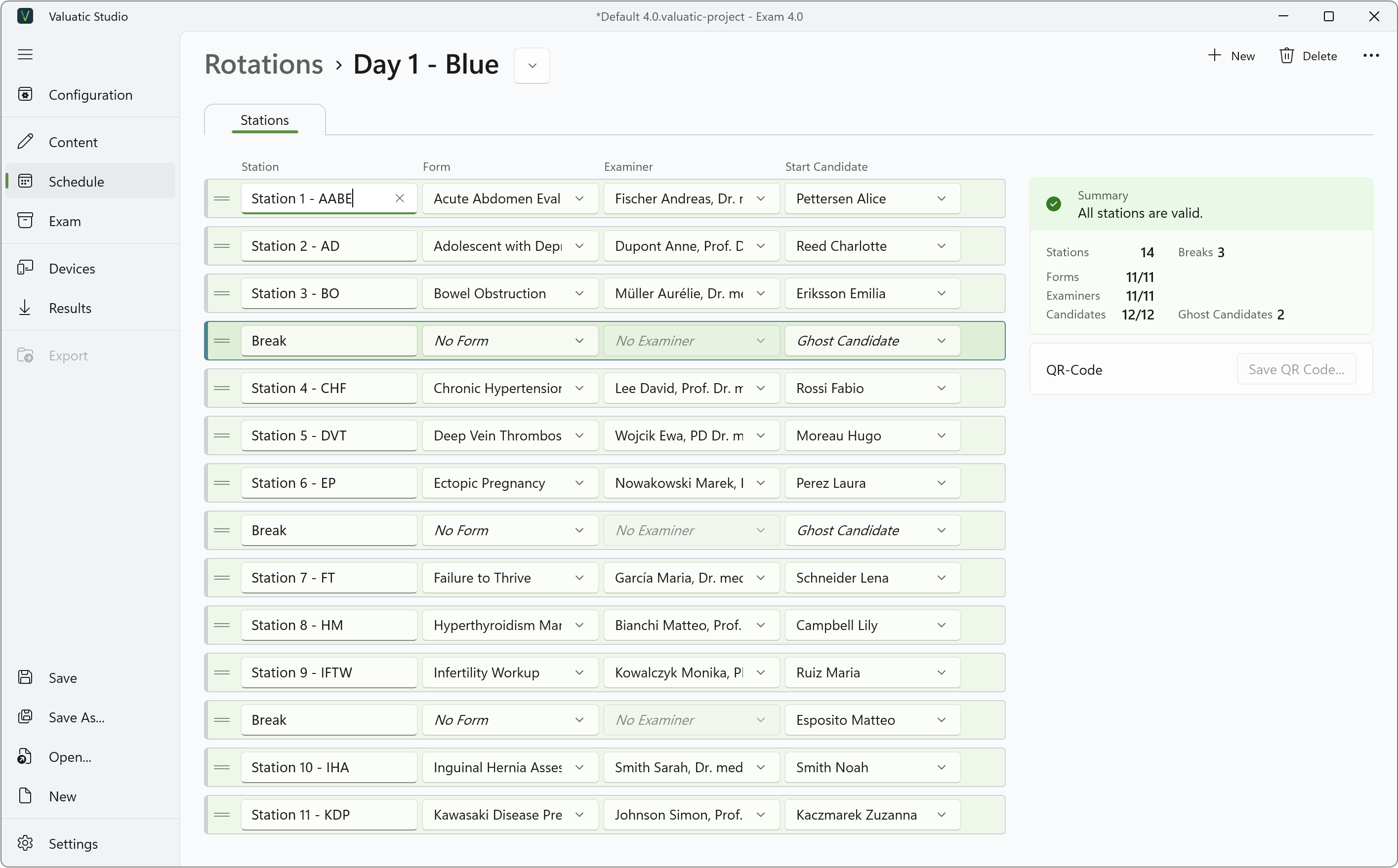
Each station consists of:
- Station - The name of the station. It can be edited directly in the text field.
- Form - The form the examiner will use to rate the candidates at this station.
- Examiner - The examiner assigned to this station.
- Start Candidate - The candidate who begins the rotation at this station. All other candidates are derived from the rotation order.
Note: Only content matching the tags of the rotation is offered in the stations dropdowns.
Generate Stations
Instead of assembling everything by hand, the Generate Stations action creates and populates the stations automatically. Based on the content available for the rotation, Valuatic knows how many stations are needed: one station per available form, plus break stations if there are more candidates than forms.
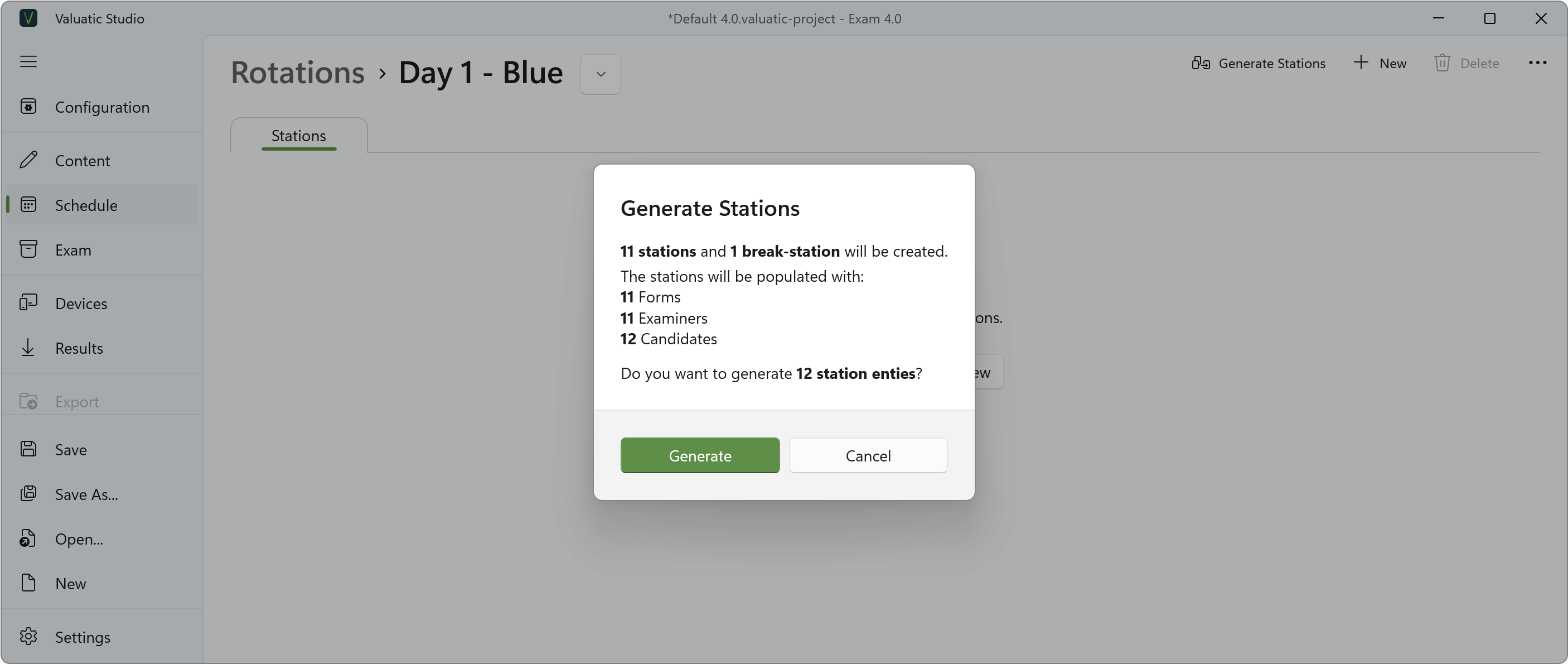
A confirmation dialog summarizes what will be created — the number of stations and break stations, and how many forms, examiners, and candidates will be assigned — before anything is changed. Click Generate to create the stations or Cancel to abort.
Note: Generating stations replaces the current station setup of the rotation. You can still adjust every assignment manually afterwards.
Manual Editing
All aspects of a rotation can also be managed manually:
- New adds a station to the rotation.
- Delete removes the selected station.
- Stations can be rearranged by dragging the handle on the left of each row. The station order defines the rotation order of the candidates.
- Every station name and each form, examiner, and start candidate assignment can be changed individually.
Break Stations
A station can be marked as a break station. Break stations have no form and no examiner — candidates passing through simply have a pause in this round. Break stations are needed whenever there are more candidates than active stations, so that every candidate has a place in each round.
Ghost Candidates
If a rotation has more stations than candidates, a Ghost Candidate can be selected as start candidate. A ghost candidate is a placeholder that keeps the rotation consistent — the corresponding station simply stays empty during that round.
Summary and Validation
The panel on the right-hand side shows a live summary of the rotation:
- The validation state, e.g. All stations are valid. Invalid configurations, such as unassigned forms or duplicate assignments, are reported here.
- The number of stations and breaks.
- How many of the available forms, examiners, and candidates are assigned (e.g. Forms 11/11, Candidates 12/12), plus the number of ghost candidates.
QR Code
Like other screens in Valuatic Studio, the station setup provides a QR code via Save QR Code… which can be used to easily select a station to Valuatic Touch.